Pico MZ-80K now with Pico 2 support
I've temporarily given up on the floppy disk emulation for the Pico MZ-80K. I've managed to get the read emulation working reliably, but not writing. I appear to be missing a status register flag that tells the controller to stop writing and where to restart ... but I haven't been able to work out what I need either by looking at disassembled utilities (they're too high level for once!) nor by deciphering the hardware manual's rather strange version of English.
Oh well - I'm not the only person who seems to have hit a brick wall while trying to do this. I've found other emulators that can read Sharp MZ disks, but also not manage to write them.
Instead, I've headed back to my issues list and sorted out Pico SDK 2.x support, which led naturally onto looking at Pico 2 support.
This has necessitated clocking the Pico 2 down from the default 150MHz to 100MHz, and adding a small delay into the main loop ... and even after that, I'm still running a little too quickly (a couple of percent) when compared with the genuine article. Good enough though.
Perhaps the next RetroChallenge will see me creating an MZ-700 emulator, as the Pico 2 will be more than fast enough to make this possible without too much over clocking.
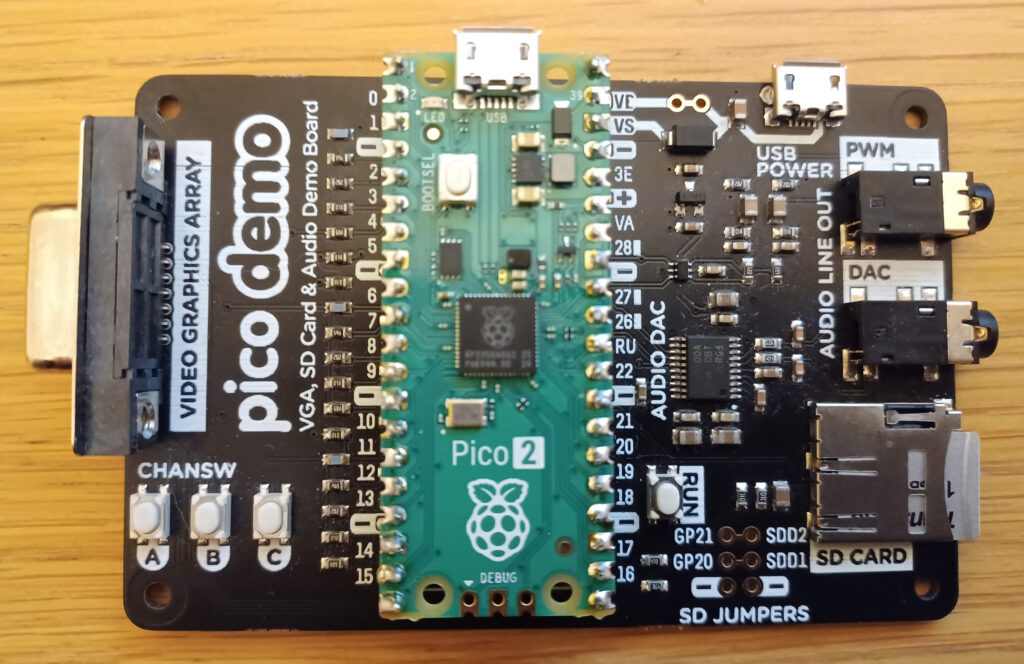
This release (version 1.1.0) is still restricted to the Pimoroni VGA board, but I've started experimenting with their DVI board, as well as with the RP2040 VGA board for the RC2014.
December is rapidly approaching. I think I need a break from the MZ-80K, so I'm probably going to spend the month shouting at Advent of Code once more. I've not decided on a language to use, but it will either be Pascal (as last year) or Fortran.
If I decide on Fortran, it will probably be Fortran 90 - or perhaps Fortran 77 if I'm feeling slightly more masochistic. Definitely not Fortran 66 or Fortran IV however ...