Pascal – a false idol?
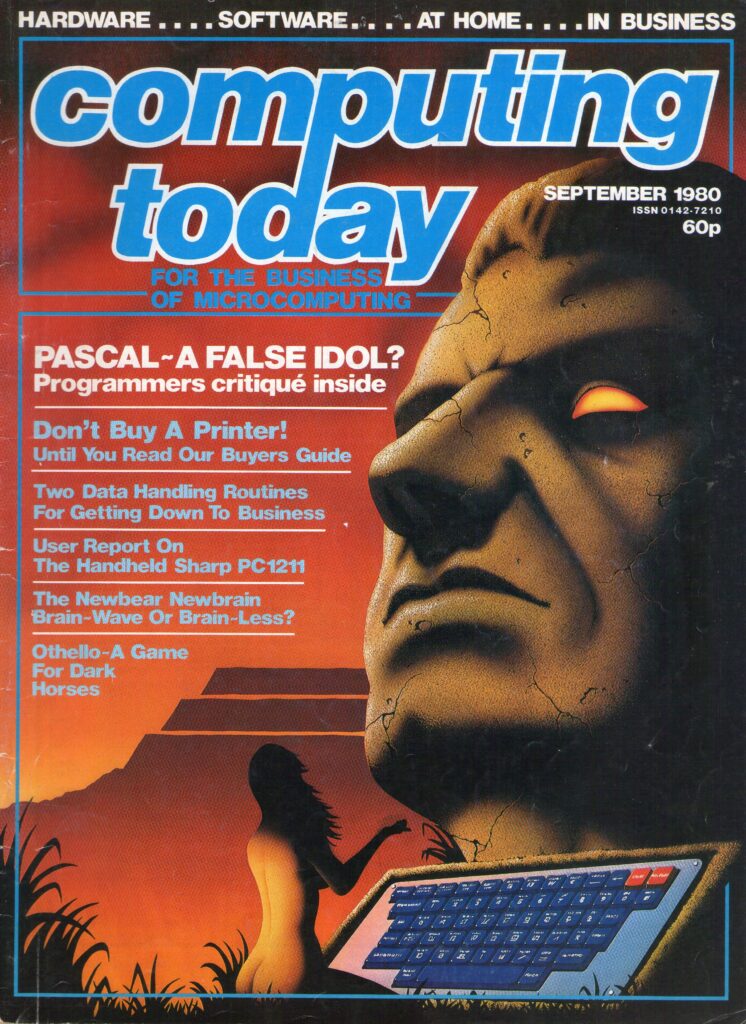
The front cover of my copy of Computing Today from September 1980 is, by 2021 standards … odd. Just as odd for a magzine dedicated to the 80s microcomputer scene (think Microsoft 8K BASIC and assembly code) is the lead story on Pascal. If you’d bought the magazine expecting a rational comparision of Pascal and the alternatives, you were probably somewhat disappointed by the page and a bit of text that was actually published.
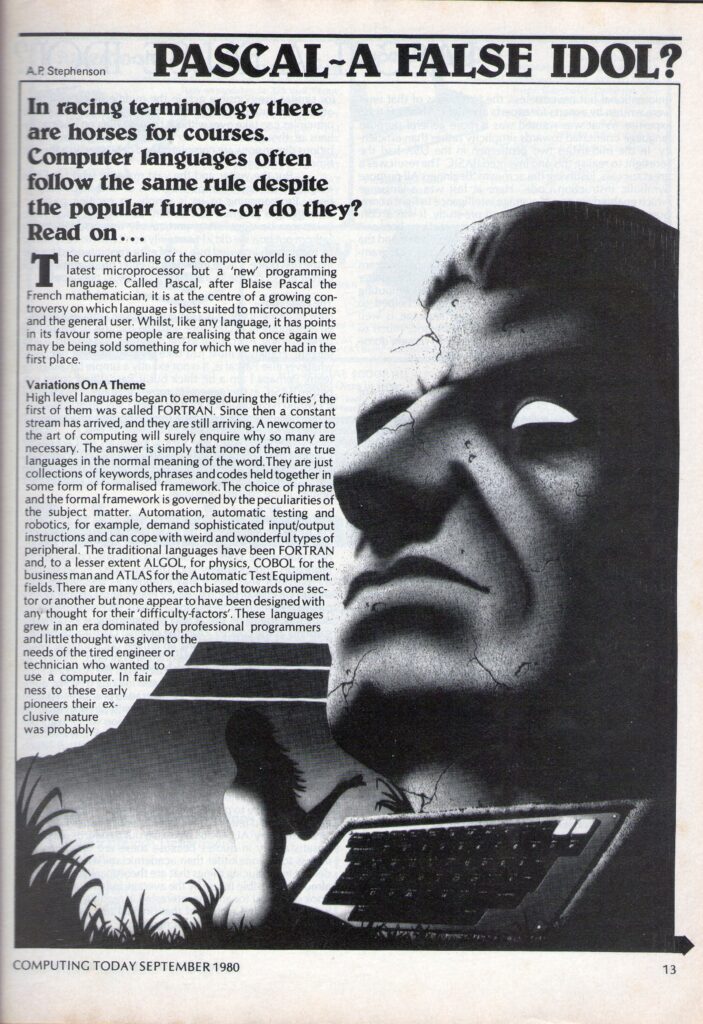
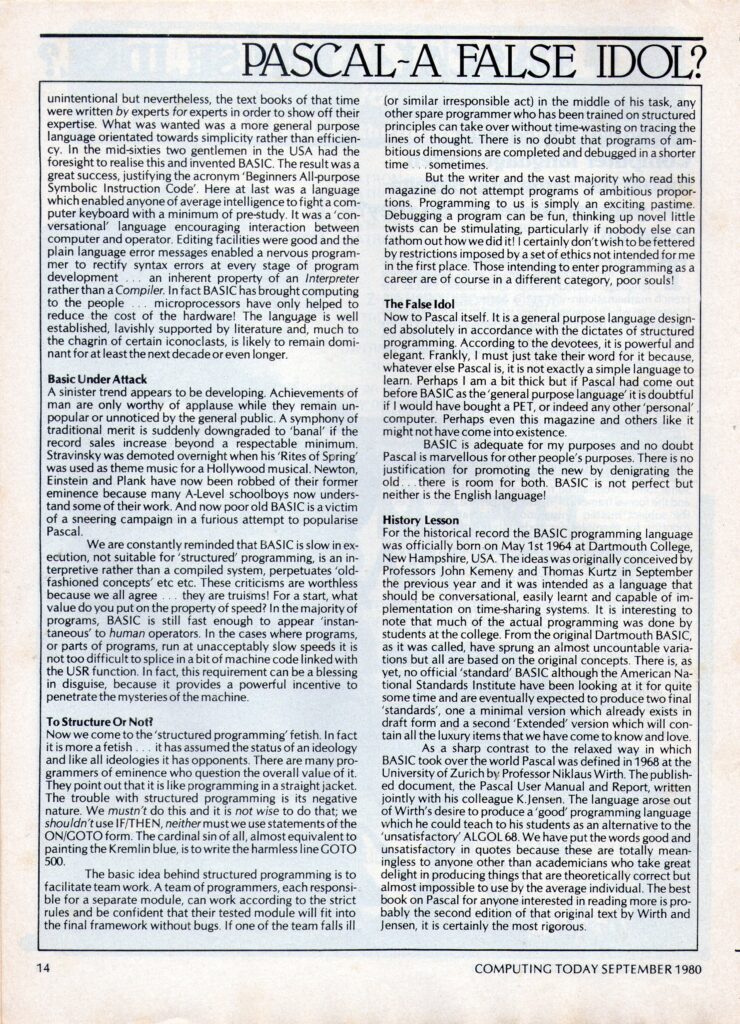
The article can probably be best summarised as:
” I love BASIC, it lets me write dreadful code that no-one else can understand. How *dare* someone suggest that writing better code might be more fun than hunting down all my obscure bugs because GOTO”.
I subsequently spent the first term of my Computer Science degree in late 1982 learning UCSD Pascal on a Vax 11/750 running BSD Unix. Interestingly, my university tutor’s biggest concern about BASIC was not that you couldn’t write well-structured code using it (you could, just about, with great care) – but what happened when you ran out of line numbers?
Depsite the author’s concerns for those of us that took programming up as a career FORTRAN and C dominated the coding landscape at my first employer, followed by a foray into Ada in the early 1990s. If A. P. Stephenson was horrified by the straightjacket of Pascal, then Ada would have made him apopleptic with rage. But I doubt any Ada compiler could ever have worked on a 1980s 8 bit microcomputer.
Pascal never featured in my life as a programmer to any great extent. The one exception I can think of is using it on the Apollo DN series workstations to write some low-level code in the late 80s. It certainly didn’t displace COBOL or FORTRAN, nor has it ever challenged C or Java.
In 2021 BASIC survives, albeit in a very different form – and without line numbers. No-one ever mentions Pascal.