E24 Parascan
A program to calculate which combinations of resistors from the E24 range can be placed in parallel to deliver a non-standard resistance, within a user-specified tolerance.
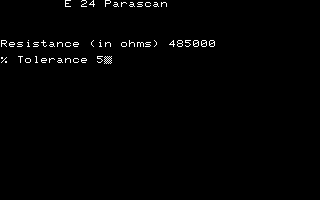
This was originally published (without the graphics) in the November 1979 edition of Practical Electronics. The graphics were originally written by me for display at a 6th form science evening, using the school’s RM-380Z. That code has been lost to history, but fortunately I converted the graphical part to work on the MZ-80K at the time.
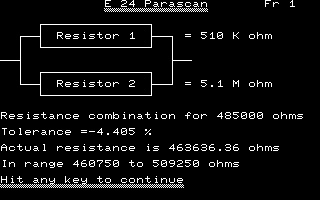
There’s also a version in my github repository (Res Parascan) that works using the values of resistors I happen to have to hand as of January 2021.
The code is simple enough to alter – change the DATA statement on lines 20 and 30 to reflect the value (in ohms) of the resistors you have. Ensure the DIMENSION statement on line 40 is the correct size for the DATA, and alter the FOR loop (also on line 40) to read the same number of values. The FOR loops on lines 230 and 235 will also need to be set to the same value.
One addition to the Res Parascan version of the code is line 300. Depending on the range of resistors you have, it’s possible that a suitable pair will not be found, so rather than crash (as the E24 Parascan code does) if this condition is met, it exits more gracefully.
Of course, it’s possible to find a resistance / tolerance pair that will break the original E24 Parascan program too, but much less likely.
If you’d like to run some of the programs I’ve archived on your own MZ-80K or emulator, you can find them in my Sharp MZ-80K github repository.